
Voter registration records
Your voter registration is technically public in most states. The downstream effect: your home address, party affiliation, and voting history are searchable on broker sites that buy the file from candidates.
Most first responders register to vote. Most don't realize the file feeds the broker pipeline through commercial channels — campaigns, pollsters, and academic researchers all buy the state file legally, then resell or republish derivatives. Filing for confidentiality with your state stops future leaks. It does nothing about what's already out there.
What an adversary sees
Pull your name on VoterRecords.com. Without logging in, the page typically shows:
- Full name and middle initial
- Date of birth or age
- Home address as registered
- Party affiliation
- Voter status (active, inactive)
- Election history — which elections you voted in
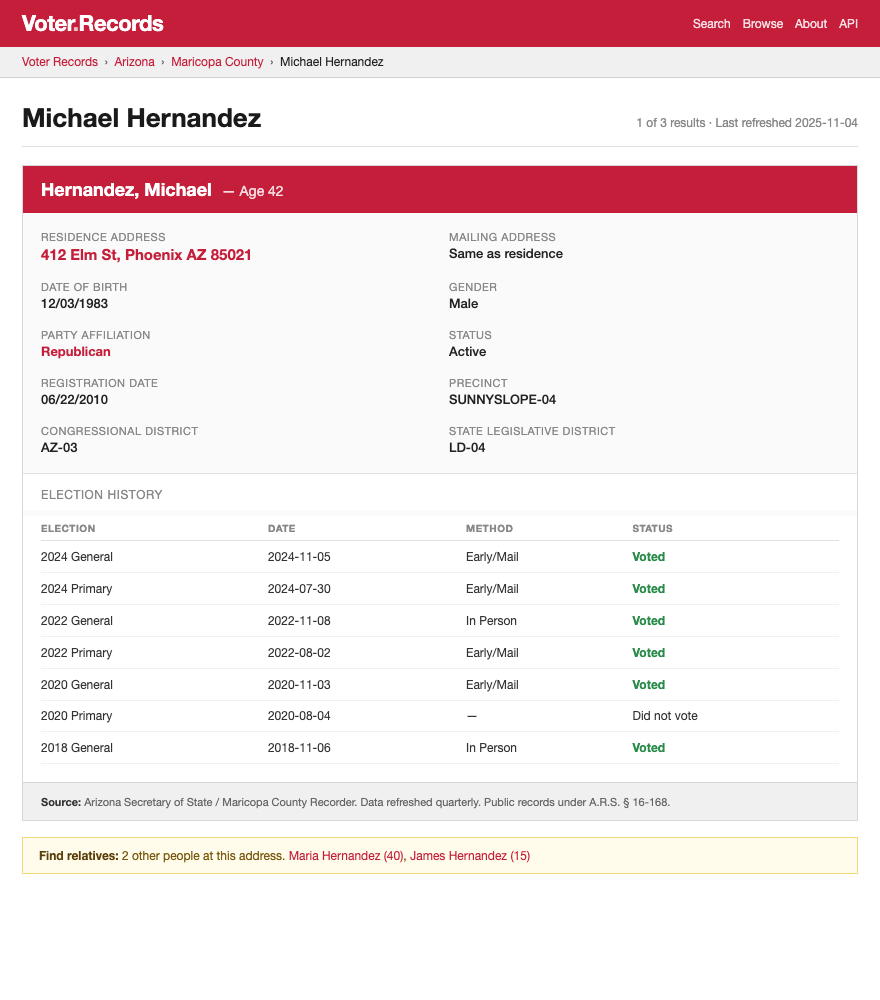
Then Spokeo and Whitepages ingest the same state file and republish the address inside their own people-search results. Other downstream broker pages cite "voter registration" as the source. Once a candidate's campaign buys the file and a vendor scrapes their published walk lists, the data has spread to a dozen sites that all need to be opted out separately.
For an officer, the chain runs: name into search → broker page → home address tied to political affiliation. That last piece becomes its own threat vector when current events run hot.
How to do this on yourself
Search your name across the voter-record broker stack.
- VoterRecords.com — the largest republisher. Search by state, then by name.
- Spokeo — voter data appears in the "political" or "additional info" section.
- Whitepages — address often originates from voter file.
- Your state's official voter lookup — confirms what's on file with the state.
- Google:
"First Last" voter,"First Last" registered voter— surfaces secondary republishers.
Note every site that lists your address. Note whether the party affiliation is published. That tells you which republishers are pulling fresh state data.
What to do about what you find
Two-step. Close the source, then clean the downstream.
- File your state's voter-registration confidentiality election. If you're sworn LE, a judge, a prosecutor, or in a similar protected category, most states have a statutory mechanism. New Jersey's Daniel's Law — a state statute that lets covered officers and judges force brokers and other publishers to remove their home address — covers it. California has an Address Confidentiality Program (ACP) — a substitute-address program from the state — through Safe at Home. Texas has its own ACP. Federal personnel get coverage under the Lieu Act. See voter-roll exposure for a state-by-state breakdown.
- Run broker opt-outs. The confidentiality election only closes future state disclosure. The address already in the broker pipeline stays there until each broker is opted out individually and the data is monitored to make sure it doesn't repopulate.
Order matters. File the confidentiality election first so the next state file release doesn't undo the broker cleanup. Then start the opt-outs.
What we handle automatically
We handle the broker layer continuously, including the voter-record-derived ones — VoterRecords, Spokeo, Whitepages, and the long tail of secondary republishers that cite voter data as source. A free scan shows which currently list your address.
We do not file your state confidentiality election for you. That's a form-and-affidavit process the agency or you handle directly. We point you at the right form for your state and explain what it does. The two pieces — the source and the broker layer — only work together. Run both. For the full sequence, see how to remove your home address from the internet.
Most OSINT chains end at a broker page that ties your name to a home address. Run a free scan to see what's currently exposed.