
Property records OSINT
County recorders publish your deed, your mortgage, your tax record. Free, indexed, scraped by brokers within weeks. The single largest broker-feeding pipeline in the country.
Property records are the workhorse of address-finding work. OSINT is the work of digging up what's public about a person — searching, cross-referencing, putting the pieces together. Every state publishes property records through county recorders or assessors. The publishing happens automatically the day you close on a house.
What an adversary sees
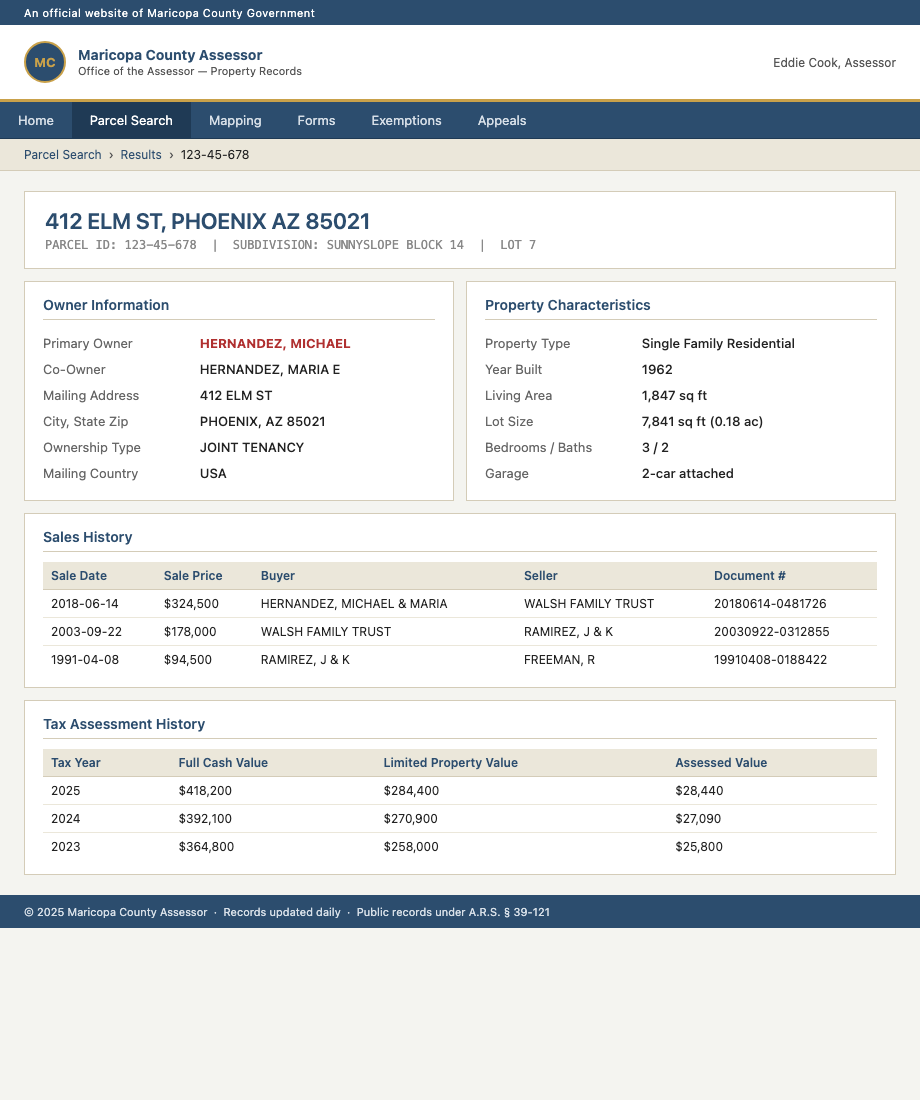
County property data is a one-stop shop. A name search at the recorder or assessor returns a complete file:
- Current owner of record and any prior owners going back decades
- Sale date, sale price, and the recorded deed PDF with your signature
- Mortgage amount, lender, and the satisfaction-of-mortgage filing if paid off
- Parcel number and exact GPS coordinates of the lot
- Annual tax assessment, square footage, bedrooms, year built
Then they pull it onto a map. ClustrMaps takes the parcel coordinates and drops a literal pin on your roof. The deed PDF gives them your signature. The sale price tells them what's worth taking.
How to do this on yourself
Hit your county directly first. Brokers come second.
- Search your name in the county recorder's online portal — every state has one, names vary (Register of Deeds, Clerk-Recorder, Land Records). Pull every document tied to you.
- Search the county assessor for the tax record on every property you've owned. Note what's public: owner name, mailing address, assessed value.
- Run yourself through ClustrMaps and screenshot the map view. That is what your stalker sees.
- Check neighboring parcels — sometimes your spouse or an LLC holds title and your name leaks through the mortgage filing instead.
Do this for every county you've ever owned in. Old addresses still index against your name on the broker side.
What to do about what you find
State-level redaction is the only fix at the source. The mechanism varies:
- Texas — Tax Code §25.025 lets sworn personnel, judges, and certain others request the assessor mask their name and address. Clean process, fast turnaround. See Texas.
- California — Safe at Home for survivors and at-risk individuals; the address confidentiality program substitutes a state-issued mailing address.
- New Jersey — Daniel's Law (a state statute that lets covered officers, prosecutors, and judges force brokers and government records-holders to remove their home address) covers sworn personnel, prosecutors, and judges. The state forces the redaction; you don't have to negotiate with the county.
- Florida — F.S. §119.071 carves out exemptions for officers and judges. File with each agency that holds the record.
Title the new house in a trust or LLC where statute allows. The deed still records, but the name on it isn't yours.
What we handle automatically
We handle the broker side — the layer that scraped your county record before you filed any redaction and republished it across Spokeo, Whitepages, USPhoneBook, and the rest.
State redaction is on you. We can't file Daniel's Law paperwork on your behalf, and we can't make Tarrant County strip your name. But we can — and do — kill the downstream copies that brokers built off the original publication. See property-record exposure for the full breakdown of how the pipeline works, and how to remove your home address from the internet for the end-to-end removal walkthrough.
Run a free scan to see which brokers have your address tied to your current property today.
Most OSINT chains end at a broker page that ties your name to a home address. Run a free scan to see what's currently exposed.