
Court record OSINT
Court dockets publish names, addresses, case details. State court systems vary in what they put online. Federal PACER is its own ecosystem. All of it gets scraped by court-record aggregators that feed broker pages.
Court records are a high-quality input for anyone digging into you because the data is sworn — courts treat it as authoritative. (OSINT is the work of digging up what's public about a person — searching, cross-referencing, putting the pieces together. Court records are some of the cleanest source material out there.) The broker pipeline picks that authority up and republishes it. A divorce filing from 2014 with a then-current home address can still be the cite that anchors a broker page today.
What an adversary sees
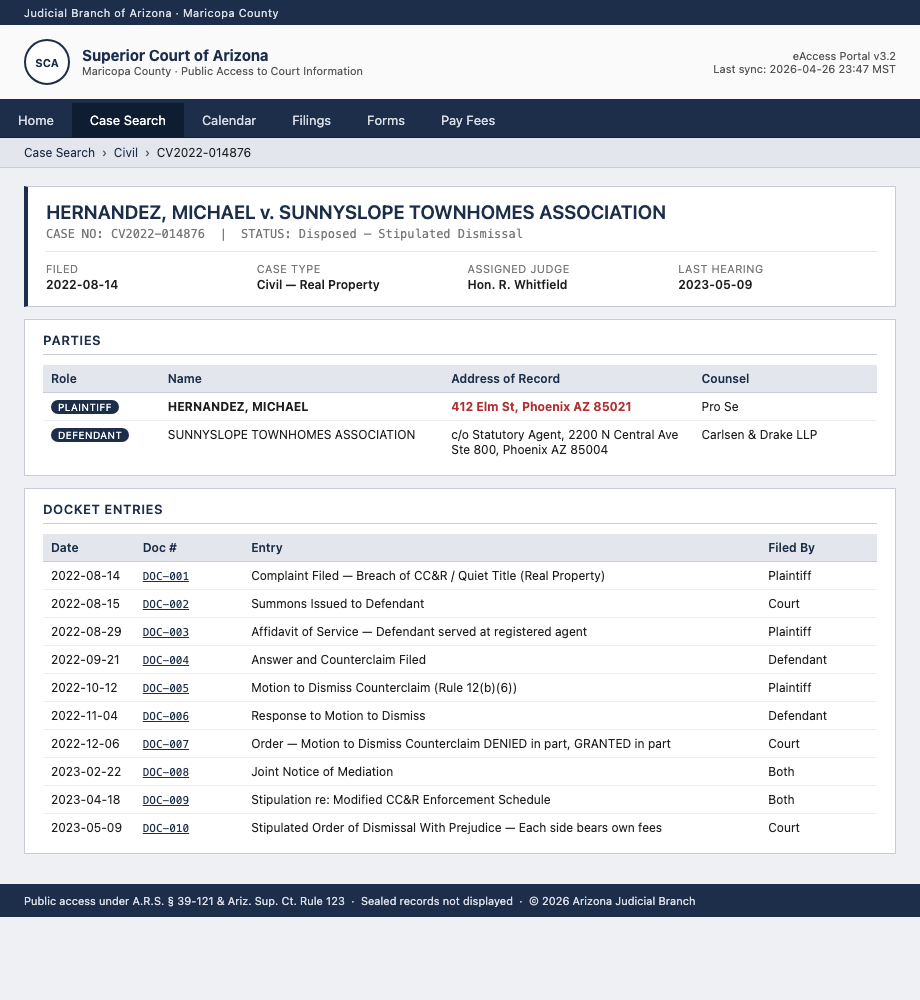
Court records are dense. From a single state-court civil filing, an analyst typically pulls:
- Party name and address from the caption — petitioner and respondent both
- Attorney names and bar numbers
- Judge name, courtroom, hearing dates
- Witness names where they appear in transcripts or motions
- Co-defendant names from criminal filings, which build out a network map of who you've been associated with
- Property addresses from civil cases — divorce decrees often list every parcel and bank account
Federal PACER is a separate system covering federal civil, criminal, bankruptcy, and appellate cases. PACER is paywalled per page but still public. LexisNexis, Westlaw, and CourtListener republish federal cases. UniCourt and others do the same for state court. Brokers pick all of it up and label it "verified public records."
How to do this on yourself
Search yourself across the court-record stack.
- Your state's court portal — most states have a public case search. Search your full legal name. Check civil and criminal indexes separately.
- PACER (pacer.uscourts.gov) — search "First Last" if you've ever been a federal party, witness, or affiant.
- CourtListener — federal opinions and dockets, free and indexed.
- UniCourt and Trellis (free tier) — state court aggregation, useful for cross-state.
- LexisNexis or Westlaw — if you have agency access through a prosecutor or legal department, run the same query.
- Google:
"First Last" docket,"First Last" v.,"First Last" case no.
Note every filing that includes your home address in the caption or in an exhibit. Note every cross-reference to a relative's name.
What to do about what you find
Court records are harder to scrub than broker pages but not impossible.
- Redaction at filing time. When you're a party to a new filing, ask counsel to redact the home address from the caption and from exhibits. Most courts allow the use of an alternate service address for protected categories. Some states require a judge's order.
- Sealing. For personal-life filings — divorce, custody, restraining orders where you're the protected party — request sealing under your state's rule. Standards vary. Sealing is not guaranteed but is granted more often than people assume.
- Confidentiality election. File the relevant state election so future filings default to a non-public address. Broker-removal statutes — Daniel's Law is the original (NJ's law that lets covered officers and judges sue brokers that won't remove their home address) — cover this in a growing number of states.
- PACER and federal. Federal Rule 5.2 redaction applies. If you're identified as a witness or victim in a sealed-by-default category, ensure the U.S. Attorney's office actually filed under seal.
See court records exposure for state-by-state guidance and the templates.
What we handle automatically
We handle the broker layer — the downstream pages that ingest court-record data and republish your home address inside a people-search result. A free scan shows which currently list the address.
The court-side requests — redaction, sealing, motions — are on you or your counsel. No third-party service can file a motion in your name. We give you the playbook at court records exposure and the broker layer takes care of itself once we're running. Together that's the full picture: source plus distribution.
Most OSINT chains end at a broker page that ties your name to a home address. Run a free scan to see what's currently exposed.